
History etiketine sahip kayıtlar gösteriliyor. Tüm kayıtları göster

7 Temmuz 2016 Perşembe

Visigoths - From Aranism to Catholicism and the Situation of the Jews

Share this PostPin ThisEmail This

Wikipedia - Visigoths Article [English]

When the Visigoths took over Spain, Jews constituted a large and very ancient proportion of the population. Many were farmers, but they worked in a wide range of occupations, and were a major component of the urbanized population of the larger towns particularly of eastern Spain. During the period in which the Visigoths adhered to Arianism, the situation of the Jews seems to have remained relatively good. Previous Roman and Byzantine law determined their status, and it already sharply discriminated against them, but royal jurisdiction was in any case quite limited: local lords and populations related to Jews as they saw fit. We read of rabbis being asked by non-Jews to bless their fields, for example.[47] "Some Jews held ranking posts in the government or the army; others were recruited and organized for garrison service; still others continued to hold senatorial rank."[48] In general, then, they were well respected and well treated.

However, this changed with the conversion of Reccared I to Catholicism in 589. Catholic conversion across Visigothic society reduced much of the friction between their people and the native Spanish population.[49] One chief purpose of this conversion was to unify the realm under the Church, and one of the key complaints of the Church had long been that Jews had too much status, prosperity and influence. Local nobles relied on their Jewish and non-Jewish sectors of the population to enhance the local economy and the noble's independent power. Visigothic political structure had traditionally given extensive powers to local nobles (who even elected their kings), so the king was in many ways merely 'the first amongst equals,' and central authority was weak. The status of the Jews therefore impacted both symbolically and politically on local aristocrats. Almost immediately, therefore, King Reccared convened the first Council of Toledo to "regulate" relations between Christians and Jews. The discriminatory laws passed at this Council seem not to have been well nor universally enforced, however, as indicated by several more Councils of Toledo that were held in subsequent years that repeated these laws, and extended their stringency. These entered canon law and became legal precedents in other parts of Europe as well. The culmination of this process occurred under King Sisibut, in 613, with a decree ordering the forced conversion of all Jews in Spain. However, even this apparently achieved only partial success: similar decrees were repeated with increasing irritation and effect by later kings, as central power was consolidated. These laws either decreed the forcible baptism of the Jews or forbade circumcision, Jewish rites and observance of the Sabbath and festivals. Throughout the seventh century, Jews were flogged, executed, had their property confiscated, were subjected to ruinous taxes, forbidden to trade and, at times, dragged to the baptismal font. Many were obliged to accept Christianity but continued privately to observe the Jewish religion and practices.[50] The decree of 613 set off a century of torment for Spanish Jewry, which was only ended by the Muslim conquest.[51]

7 Mart 2016 Pazartesi

Jihad in the Rakhine State (Arakan)

Share this PostPin ThisEmail This

The Rakhine State, former called Arakan, is a province in the West of Myanmar (Burma). The country was in british rule until 1948. The muslim rohingyas in the north of Arakan wanted to be independent from the rest of Myamar. As the independence struggles started in Pakistan, the muslims rohingyas demanded to merge with Eastpakistan (after 1971 Bangladesh). Two months later the Arakan Muslim League was founded, but Mohammad Jinnah, later president of Pakistan and leader of the Muslim League refused it, saying that he doesn't want to interfere in burmese matters. After the Independence of Myanmar in 1948, North Arakan also became a part of the new burmese state.

The muslim rohingyas founded the Mujahid party as a jihad movement. Jihad movements whose foundations were laid at that time still exist today. After General Ne Wins coup, a military operation started, thus activity of those movements became less. (Source: Wikipedia)

Some excerpt of Page 42, talking about Jihad in Arakan

6 Şubat 2016 Cumartesi

Muslims Crossed The Atlantic Before Columbus

Share this PostPin ThisEmail This

The old poem that most American school children recognize begins “In 1492, Columbus sailed the ocean blue…” Indeed, in the year 1492, Christopher Columbus (whose real name in Italian was Cristoforo Colombo) sailed across the Atlantic in the name of the Spanish crown and landed in the Caribbean part of North America.

For hundreds of years, it has simply been accepted that Columbus was the first explorer to valiantly sail across the sea and “discover” the Americas. However, this theory no longer stands up to modern scholarship.

It goes without saying that the first people to truly discover America were the ancestors of the Native Americans, who probably crossed into North America through Russia and Alaska about 12,000 years ago. Discussion of the “discovery” of the Americas by Europeans, Africans, or Asians is an insult to the history of its indigenous peoples. That said, the first daring souls to cross the Atlantic Ocean by boat are important to know, and the theory of Columbus does no justice to their story.

While the common knowledge about Columbus is that he lived in a time where everyone assumed the world was flat, this is clearly not the case. Ancient Greek scholars such as Aristotle and Pythagoras suggested that the earth was in fact, round.

It was during the Muslim Golden Ages (c. 750-1100s) that advanced scholarship into the shape and size of the earth began. Contrary to what most people may believe, in those years, it was common understanding that the earth was not flat. The debate, instead, was about exactly how large the earth was. In the early 800s, the Abbasid Caliph al-Ma’mun assembled the brightest minds of the day (including al-Khawarizmi) in Baghdad who calculated the earth’s circumference and were off by only 4% of its actual size.

Knowing that the earth was round, and knowing its size to a very good degree of accuracy (without the modern technology we have today), some intrepid Muslims must have attempted to go around the world, hundreds of years before Columbus. The proof of these voyages is in front of us, in black and white.

Muslim Spain


The great Muslim historian and geographer Abu al-Hasan al-Masudi wrote in 956 of a voyage in 889 from al-Andalus (Muslim Spain). that sailed for months westward. They eventually found a large landmass across the ocean where they traded with the natives, and then returned to Europe. Al-Masudi records this land across the ocean in his famous map and refers to it as “the unknown land”.

Two more voyages from Muslim Spain to the Americas are recorded in history. One was in 999 and was led by Ibn Farrukh, from Granada. The other is recorded by the genius mind of the geographer al-Idrisi, who worked in the multi-cultural and religiously tolerant Sicily of King Roger II in the 1100s. He wrote of a group of Muslims who sailed west from Lisbon for 31 days and landed on an island in the Caribbean.

They were taken prisoner by the Native Americans on that island for a few days. Eventually, they were freed when a translator who lived among the natives that spoke Arabic arranged for their release. They eventually sailed back to al-Andalus and told their tale. The important part of this account is the existence of an Arabic speaker among the natives, indicating that there must have been more unrecorded contact between the Arab world and the Americas.


West Africa 


There is another part of the Muslim world that had contact with the Americas before Columbus. In West Africa in the 1300s, a powerful and incredibly wealthy empire called Mali existed. The most famous leader of this empire was Mansa (King) Musa. The most memorable event of his reign was his epic hajj journey in 1324.

The caravan of over 60,000 people made an impression everywhere they went, including Egypt, where Mansa Musa told the story of how he came to power. His brother, Abu Bakr was the Mansa before he was.

During his reign, Abu Bakr sent a fleet of 400 ships to explore the Atlantic Ocean. Only one ship returned, which reported that they found a land across the ocean. Mansa Abu Bakr then outfitted a fleet of 2000 ships, which he sailed with personally, that sailed west into the ocean. They were never heard from again.

While there is no record in Mali of the result of that voyage, there is evidence of their arrival in the Americas. There are numerous archaeological sites in North and South America that attest to that Malian presence.

Early Spanish explorers and pirates recorded abandoned cities in Brazil that had inscriptions identical to the language of the Mandinka (the people of Mali).

More inscriptions in the Mandinka language were found in the United States as well. Near the Mississippi River, many inscriptions exist that recorded their exploration of the Americas. In Arizona, an inscription was found that reads “The elephants are sick and angry.

At present there are many sick elephants”. This inscription also includes a rough sketch of an elephant. Elephants are not native to the Americas. They were brought by the Mandinka to the Americas, and the inscriptions are proof of Mansa Abu Bakr’s successful journey over 100 years before Columbus.


The Ottoman Empire


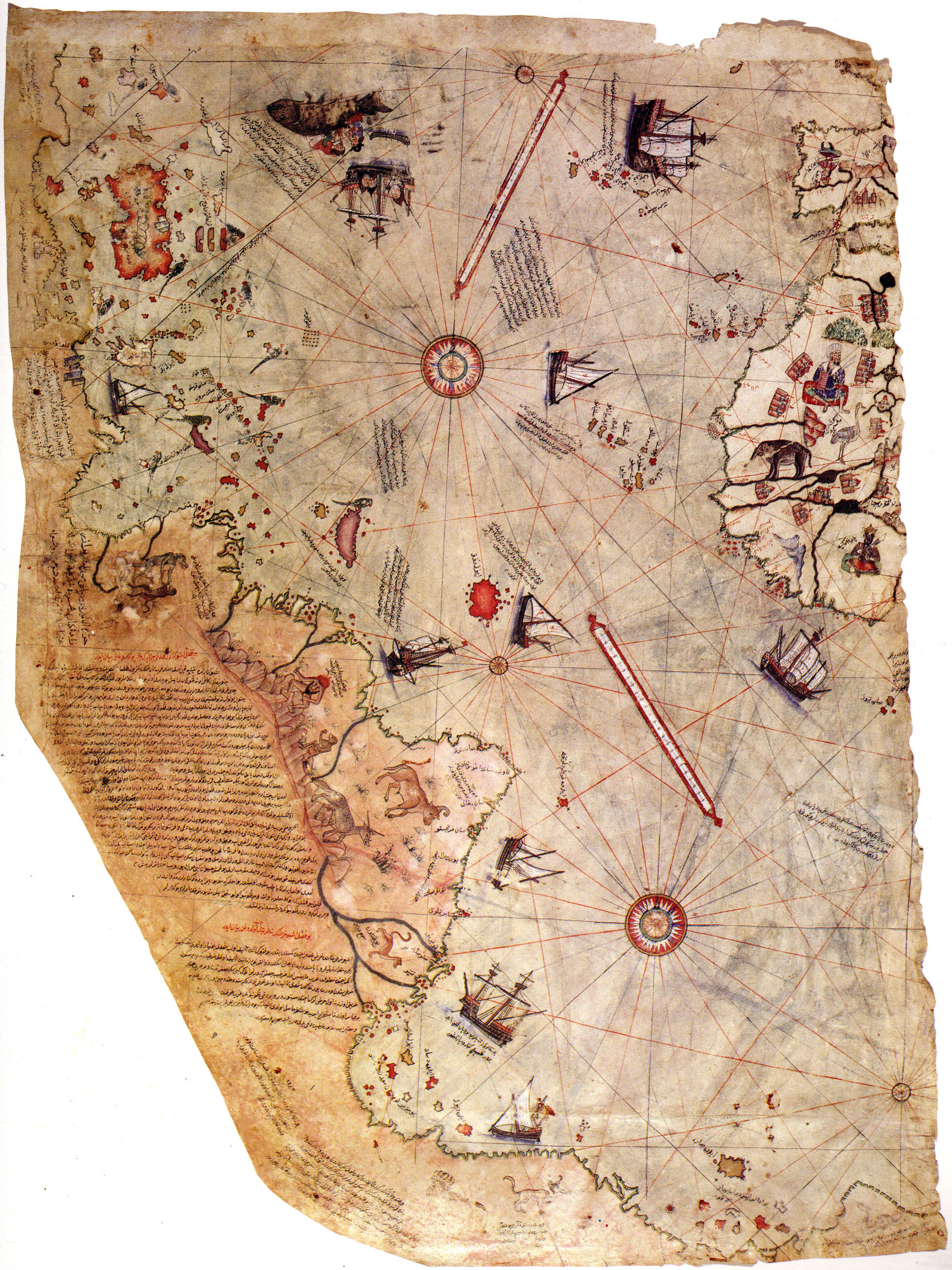
In 1929, an amazing discovery was made in Istanbul, Turkey. A map drawn in the year 1513 by the Ottoman cartographer, Piri Reis was found. Reis wrote that his map was based on earlier sources, including ancient Greek and Arabic maps, including maps by Christopher Columbus, who had sailed only 21 years earlier. What is remarkable about this map is the level of detail of the map, which forced historians to re-evaluate the Columbus theory of exploration.


The map clearly shows the eastern coast of South America, which is in the correct position with regards to Africa. The coast of Brazil is shown in incredible detail, with many rivers accurately placed on the map. Although Reis used Columbus’s maps as a source, Columbus never went to South America, so Reis must have gotten that from earlier Muslim maps that he used as sources. Furthermore, Reis’s map includes the Andes Mountains, which were not even explored by Europeans until the 1520s, a full decade after the drawing of Reis’s map!


Piri Reis based his map on earlier sources, which clearly had a very good understanding of the Americas and had explored the area well before the first Europeans. The map is perhaps the strongest physical evidence of Muslim exploration of the Americas before Columbus


SOURCE: Lost Islamic History

26 Aralık 2015 Cumartesi

Websites for Islamic History

Share this PostPin ThisEmail This

also available in Arabic, French, Italian, Spanish, Chinese, German and Japanese.